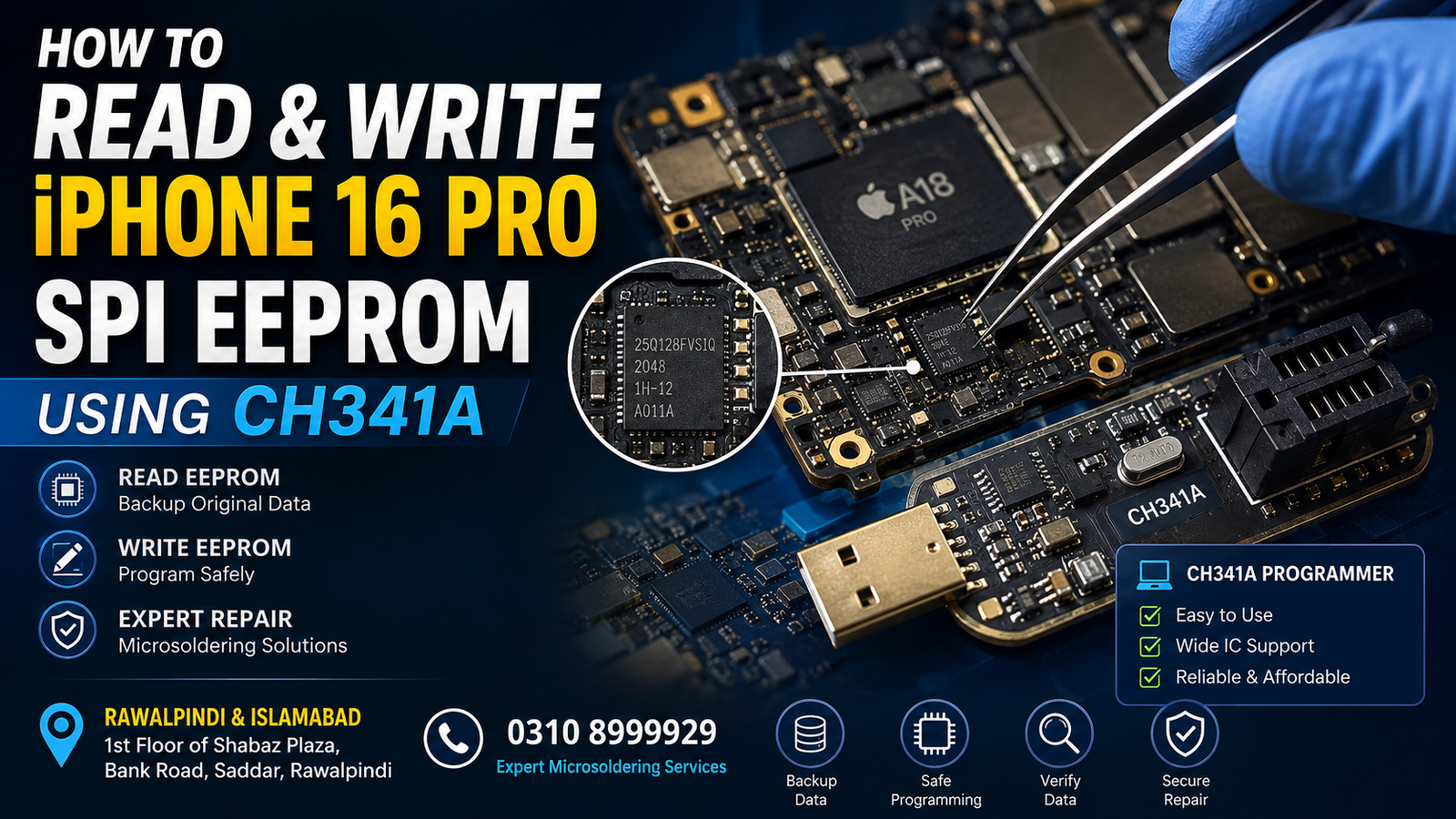
Repairing modern iPhones at board level requires more than replacing screens, batteries, or charging ports. When an iPhone 16 Pro has an SPI EEPROM-related issue, technicians may need to inspect, read, back up, or write SPI EEPROM data using specialized programming equipment such as the CH341A programmer.
For technicians and advanced repair professionals in Rawalpindi and Islamabad, understanding the correct EEPROM workflow can help with board diagnostics, data verification, and certain programmable-component repairs. However, the iPhone 16 Pro uses a highly integrated board architecture, so SPI EEPROM work should be performed only after the exact memory device, circuit function, voltage requirements, and data structure have been positively identified.
At Microsoldering Repairs / Microsoldering Service Centers, located on the 1st floor of Shabaz Plaza, Bank Road, Saddar, professional microsoldering and board-level diagnostic services are available for complex iPhone motherboard problems.
Office Contact: 0310 8999929
What Is SPI EEPROM?
SPI EEPROM is a type of non-volatile memory that communicates with a device through the Serial Peripheral Interface (SPI) protocol. It can retain information even when power is removed.
Depending on the circuit, an SPI memory chip may contain configuration information, calibration data, device-specific parameters, firmware-related information, or other data required by the surrounding electronics.
The important point for iPhone repair is that not every memory chip on an iPhone motherboard is an interchangeable SPI EEPROM, and not every chip can safely be programmed with a generic programmer.
Can You Read an iPhone 16 Pro SPI EEPROM With a CH341A?
A CH341A can read and write many compatible SPI flash and SPI EEPROM devices, but compatibility depends on the exact memory IC, voltage, package, pinout, protocol, and data requirements.
Therefore, technicians should not assume that an iPhone 16 Pro memory chip can be connected to a CH341A and programmed.
Before attempting any operation, identify:
- The exact memory IC part number
- The package and pin configuration
- Required operating voltage
- SPI protocol and supported commands
- Memory capacity
- Whether the chip is protected
- Whether the data is encrypted, signed, paired, or otherwise device-specific
- Whether in-circuit programming is electrically safe
- Whether the original data has been securely backed up
This identification stage is one of the most important parts of professional board repair.
What Is the CH341A Programmer?
The CH341A is an inexpensive USB programmer commonly used by electronics technicians for compatible memory devices.
It is frequently used for tasks involving supported:
- SPI flash memory
- EEPROM devices
- BIOS chips
- Configuration memories
- Embedded electronics
Its usefulness comes from its ability to communicate with supported memory ICs through a computer.
However, the CH341A is not a universal iPhone programmer. It cannot automatically understand every Apple memory component or repair every iPhone motherboard problem.
Important Voltage Warning Before Using CH341A
One of the biggest mistakes during SPI EEPROM programming is using the wrong voltage.
Different memory ICs can operate at different voltage levels. Applying an incorrect voltage can permanently damage the memory chip or other connected components.
Before connecting a CH341A:
- Identify the exact IC.
- Confirm its datasheet specifications.
- Confirm the required programming voltage.
- Verify the programmer’s output voltage.
- Check the adapter and pinout.
- Avoid relying solely on the markings of a generic CH341A board.
- Verify voltage with appropriate test equipment before connecting the motherboard.
Do not connect an unknown iPhone memory chip directly to a CH341A simply because the package appears physically compatible.
Basic iPhone 16 Pro SPI EEPROM Reading Workflow
A professional workflow should begin with diagnosis rather than immediately writing data.
1. Diagnose the iPhone 16 Pro Motherboard
Determine why SPI EEPROM access is being considered.
Possible reasons may include:
- Board-level malfunction
- Suspected memory corruption
- Configuration-related problems
- Previous repair damage
- Component replacement requiring data verification
- Diagnostic investigation
The exact fault should be established before programming.
2. Identify the Memory IC
Locate the suspected SPI memory device using board documentation, schematics, board views, microscope inspection, and component identification resources.
Record the IC marking and confirm the component’s specifications.
Do not rely on a visual similarity to another iPhone model.
3. Back Up the Original Data
If the memory is readable, the original contents should be preserved before making changes.
Create multiple verified copies of the original dump and clearly label them.
A good backup strategy includes:
- Original unmodified dump
- Second backup copy
- Hash or checksum where appropriate
- Repair-device identification
- Date and diagnostic notes
The original dump should never be overwritten.
4. Confirm CH341A Compatibility
Select the correct memory family in compatible programmer software.
Verify:
- Manufacturer
- IC model
- Capacity
- SPI mode
- Voltage
- Read/write support
If the exact IC is not supported, do not randomly select a similar chip from the software menu.
5. Establish a Safe Connection
Depending on the circuit, a memory chip may need to be accessed after removal from the board rather than programmed in-circuit.
In-circuit programming can be problematic because other components may remain electrically connected to the SPI bus.
Possible symptoms include:
- Incorrect identification
- Unstable communication
- Failed reads
- Corrupted dumps
- Electrical conflicts
For board-level work, technicians should determine whether isolation or chip removal is required.
6. Read the Memory
Perform a read operation and save the resulting file without modification.
Repeat the read if necessary and compare the resulting dumps.
If repeated reads produce inconsistent results, investigate the connection, voltage, chip condition, or circuit before proceeding.
7. Verify the Backup
A valid backup should be checked before any writing operation.
Comparing multiple reads can help identify communication problems.
If the data changes between reads when it should not, stop the process and diagnose the hardware.
How to Write SPI EEPROM Data With a CH341A
Writing should only be considered after the original data has been safely preserved and the replacement data has been independently verified.
A general professional workflow is:
Identify → Read → Backup → Verify → Prepare → Erase/Program → Verify
The exact process depends on the specific memory IC.
Prepare the Correct Data
Never write a random SPI EEPROM dump obtained from another phone.
Memory contents can contain device-specific information, configuration data, calibration values, identifiers, or security-related information.
Using an incompatible dump may create additional faults.
Erase Only When Appropriate
Some compatible memory devices require an erase operation before programming, while others support appropriate write operations without a traditional full erase.
Follow the memory IC’s specifications and programmer documentation.
Program the Memory
If the exact device and data are confirmed compatible, write the verified image using the appropriate programmer configuration.
Avoid interrupting power or disconnecting the programmer during programming.
Verify After Writing
A successful write operation should be followed by verification.
The programmer should read the memory again and compare it with the intended image.
If verification fails, do not assume the chip is defective. Check:
- Voltage
- Pinout
- Connection
- Software device selection
- Write protection
- Chip condition
- Programmer compatibility
Why iPhone SPI EEPROM Programming Is Different From BIOS Programming
Many technicians are familiar with CH341A because it is widely used for BIOS programming.
However, repairing an iPhone motherboard is considerably more complicated.
An iPhone’s memory architecture can involve:
- Device-specific configuration
- Security mechanisms
- Component pairing
- Cryptographic protections
- Firmware dependencies
- Calibration information
- Hardware authentication
Therefore, copying a memory dump from one device to another is not necessarily a valid repair procedure.
A CH341A is simply a communication tool. It does not bypass Apple’s security architecture or automatically make incompatible data usable.
Common CH341A Problems During SPI EEPROM Reading
CH341A Cannot Detect the Chip
Possible causes include:
- Incorrect chip selection
- Wrong voltage
- Incorrect wiring
- Poor contact
- Damaged IC
- Electrical interference from the motherboard
- Incorrect programmer configuration
Reading Produces All FF or 00
An output containing mostly FF or 00 can indicate communication or connection problems, although the correct interpretation depends on the memory device.
Check the hardware before assuming the memory is empty.
Write Operation Fails
Possible causes include:
- Write protection
- Incorrect voltage
- Incorrect device profile
- Poor connection
- Unsupported memory
- Damaged memory
- Incorrect programming procedure
Verification Fails
If the written data does not match the intended file, stop and troubleshoot rather than repeatedly rewriting the chip.
Should You Program the Chip In-Circuit?
In-circuit programming can sometimes be possible, but it is not automatically the safest method.
The surrounding motherboard circuitry can interfere with SPI communication. Other devices may share the bus, and powered circuits can create unexpected electrical conditions.
For an expensive iPhone 16 Pro motherboard, professional technicians should carefully determine whether the memory can be safely accessed in-circuit or whether controlled removal and reinstallation is required.
Equipment Commonly Needed for Professional Board-Level Work
CH341A alone is not enough for advanced iPhone motherboard repair.
A professional microsoldering workstation may include:
- Microscope
- Hot-air rework station
- Soldering station
- Quality flux and solder
- Board preheater
- Multimeter
- DC power supply
- Oscilloscope where appropriate
- Programmer
- SPI adapters
- Board-view and schematic resources
- ESD protection equipment
The exact tools depend on the fault and component involved.
Important Data and Security Considerations
EEPROM contents should be treated carefully.
Do not overwrite original data without a verified backup. Do not use another customer’s memory dump, and do not attempt to modify security identifiers or protected device information.
Professional repair should focus on legitimate diagnostics and restoration of the customer’s own hardware and data.
When Should You Avoid CH341A Programming?
Avoid programming when:
- The IC has not been positively identified.
- The voltage requirement is unknown.
- You do not have a verified original backup.
- The data source is questionable.
- The programmer does not properly support the IC.
- The motherboard is still electrically connected in an unsafe configuration.
- The issue has not been confirmed as memory-related.
For an iPhone 16 Pro, unnecessary programming makes a repairable motherboard a significantly more difficult repair.
iPhone 16 Pro Microsoldering Services in Rawalpindi & Islamabad
If your iPhone 16 Pro has a motherboard, memory, power, communication, or other board-level problem, professional microsoldering diagnostics can help determine the actual fault before components are programmed or replaced.
Services may include:
- iPhone motherboard diagnostics
- Microsoldering repair
- SPI memory diagnostics
- EEPROM-related troubleshooting
- Logic board repair
- Component-level fault finding
- IC replacement
- Board damage assessment
- Liquid-damage motherboard diagnostics
- Power and charging circuit diagnostics
For customers in Rawalpindi and Islamabad, the service location is:
1st Floor of Shabaz Plaza, Bank Road, Saddar, Rawalpindi
Office Contact: 0310 8999929
FAQs
Can CH341A read every iPhone 16 Pro SPI EEPROM?
No. CH341A compatibility depends on the exact memory IC and its electrical and protocol requirements. The chip must be identified and confirmed as compatible before programming.
Is CH341A safe for repairing the iPhone 16 Pro motherboard?
It can be useful for compatible memory devices, but incorrect voltage, pinout, connection, or programming procedures can damage components. Professional verification is essential.
Can I write another iPhone 16 Pro SPI EEPROM dump?
You should not assume that another device’s dump is compatible. iPhone memory data can be device-specific and may involve security or pairing mechanisms.
Should I erase the EEPROM before writing?
Not necessarily. The correct procedure depends on the exact memory IC and its specifications. Follow the device-specific programming requirements rather than applying a generic procedure.
What should I do before writing to the SPI EEPROM?
The most important step is to preserve and verify the original data. Make a reliable backup before making any modification.
Can EEPROM programming fix every iPhone 16 Pro motherboard problem?
No. SPI EEPROM programming is appropriate only for certain memory-related situations. Many iPhone motherboard problems originate from power, communication, charging, CPU-related, connector, or other component-level faults.
Where can I get iPhone 16 Pro microsoldering service in Rawalpindi?
Professional board-level repair is available on the 1st Floor of Shabaz Plaza, Bank Road, Saddar, Rawalpindi. For service information, contact 0310 8999929.
Is iPhone 16 Pro SPI EEPROM repair available in Islamabad?
Yes. Customers from Islamabad can access board-level microsoldering and iPhone motherboard diagnostic services in the Rawalpindi area.
Final Thoughts
Reading or writing to an iPhone 16 Pro SPI EEPROM with a CH341A requires careful identification, correct voltage, reliable connections, verified backups, and an understanding of the memory device. The CH341A should be considered a programmable-memory tool, not a universal iPhone repair solution.
For complex iPhone motherboard problems in Rawalpindi and Islamabad, proper diagnosis should always come before SPI EEPROM programming. Preserving the original data and avoiding unnecessary writes can significantly reduce the risk of further board damage.
Microsoldering Repairs / Microsoldering Service Centers
1st Floor of Shabaz Plaza, Bank Road, Saddar, Rawalpindi
Office Contact: 0310 8999929